
Perspectives from the sector: Trevor Howard, National Manager Prescribed Burning Strategy
In this edition of Perspectives from the sector, AFAC Deputy CEO and Executive Director, Strategy, People and Performance Erin Liston-Abel interviews Trevor Howard, National Manager Prescribed Burning Strategy, AFAC.
This article first appeared in Fire Australia Magazine, Issue 1, 2026
In this edition of Perspectives from the sector, AFAC Deputy CEO and Executive Director, Strategy, People and Performance Erin Liston-Abel interviews Trevor Howard, National Manager Prescribed Burning Strategy, AFAC.
Could you please tell us a bit about your career in the sector and your current responsibilities as National Manager, Prescribed Burning Strategy at AFAC?
From an early age my ambition was to work in the bush and have a life of adventure. My career started in forestry in Queensland in December 1975. I’ve since worked with land management agencies and rural fire services across the Northern Territory, New South Wales, Queensland and Western Australia in operations and program management. Along the way I completed a degree in anthropology and worked with traditional owners across northern and central Australia. I’ve also been involved in numerous major incidents, as an incident management team member and state agency commander as well as conducting post-incident reviews, preparing inquiry submissions, addressing recommendations and managing organisational change.
After many years in an agency contributing to the AFAC National Burning Project, I joined AFAC in 2022. My role has three focus areas: 1) supporting member agencies with program and operational reviews, and advice on policy, research utilisation, risk management and operational best practice, 2) developing new initiatives to address workforce changes and declining national capability, especially for complex prescribed burning, and 3) engaging with national NGOs and other organisations involved in supporting and using fire for conservation, forestry, agriculture, emissions abatement and Indigenous livelihoods. I’m fortunate to be hosted at the Bushfire Centre of Excellence in Western Australia by the Department of Fire and Emergency Services. DFES is a unique organisation leading fire and other hazards across a vast state spanning southern forests, central deserts and tropical savannas, as well as managing a large aerial burning program in the Kimberley and an innovative Cultural Fire Program.
I’m also President of the International Association of Wildland Fire.
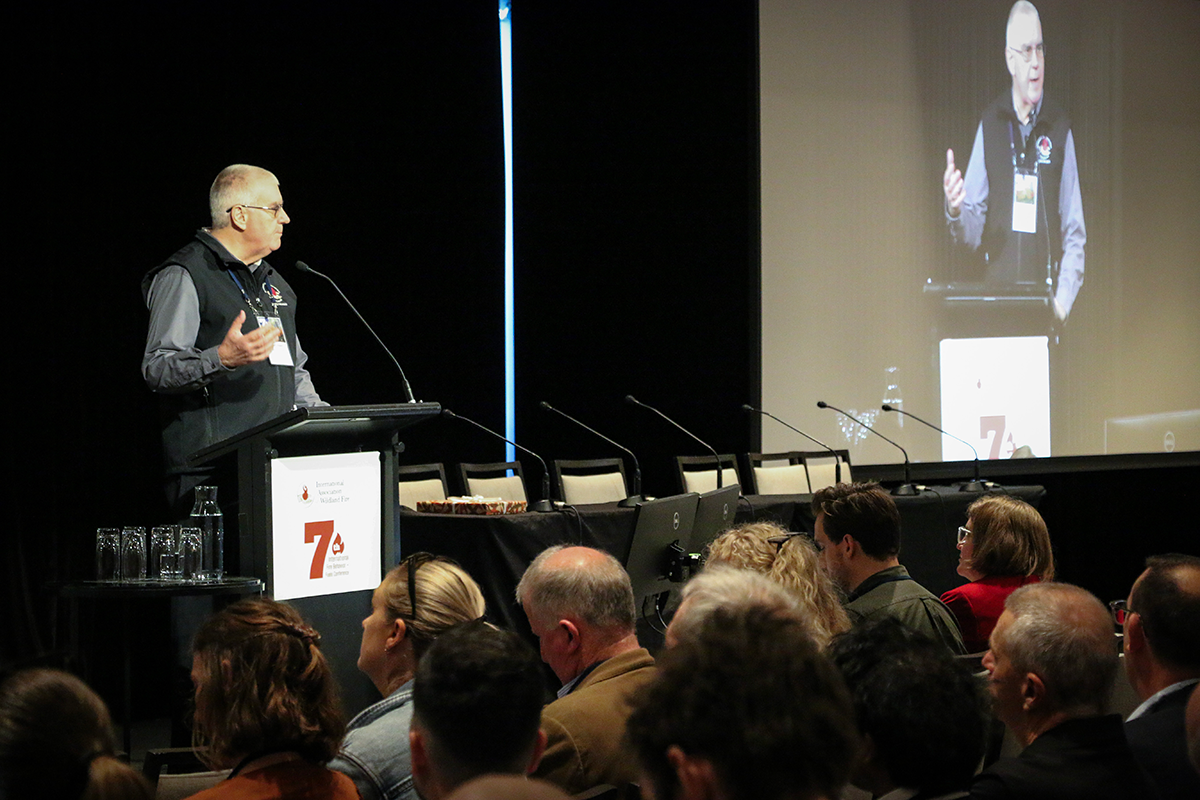
Source: International Association of Wildland Fire
Throughout your career, have you noticed many changes in prescribed burning practices?
Several things characterised the 1970s when my career started. Forestry had been the leader in fire science, innovation in equipment and technology, and a professional approach to prescribed burning and bushfire management. The use of fire by farmers, graziers and pastoralists was widespread, and departments of agriculture conducted research into fire, pastures and production and supported primary producers with extension programs. Rural fire services played a similar role in supporting community-based brigades and land managers. Society was generally more aware of rural matters and supportive of prescribed burning, but there was very little understanding or acknowledgement of Aboriginal burning.
While the grass still grows and forest fuels still accumulate, the major changes have been in rural land use, a growing urban interface, organisational arrangements including the decline of forestry and the dominance of fire and emergency services, increasing environmental regulations, and divergent socio-political viewpoints. Many operational practices continue, largely unchanged, but there are now increased constraints requiring careful and sometimes protracted planning and approvals, as well as attracting greater scrutiny. There are many positive changes including an emphasis on safety, equipment design, and multi-disciplinary science including a much closer relationship with meteorologists, some of whom are embedded in agencies to support burn programs. The historical use of fire by local people is now returning to many landscapes with the rightful recognition of Indigenous connections to land and the importance of cultural burning.
With climate change bringing more intense and frequent extreme weather, and as the higher risk weather season becomes longer, how are the emergency services adapting prescribed burning practices?
Adapting prescribed burning to the uncertainties of weather, seasons and climate change is perhaps one of our greatest challenges. On one hand, prescribed burning is becoming even more important for protecting humans, infrastructure, livelihoods and ecosystems from the impacts of extreme wildfires, while on the other hand increased governance and scrutiny can be a barrier to organisational agility. There’s an ongoing need to optimise approaches to burn programs, burn preparation and operational planning, to maximise windows of opportunity which may occur unexpectedly. There is some progress in this area, but much more needs to be done, including research and development for better seasonal outlooks, forecasts and decision support tools specifically for prescribed burning.
How do different agencies work together on prescribed burns and how important is interagency collaboration?
Each jurisdiction has made significant progress with interagency collaboration and interoperability. With land management agencies having diverse portfolios, including nature conservation, recreation and visitor management, marine parks and wildlife regulation, fire management is just one activity. Likewise, fire and emergency services deal with multiple disciplines and hazards as well as protracted year-round events including cyclones, floods and bushfires, so resources and capacity can be stretched. Working together is not an option, it is essential. We see the benefits of interstate and international resource sharing, well-managed year-round by the National Resource Sharing Centre. Resource sharing for prescribed burning is the next frontier which could bring enormous benefits, not just in managing fuels and protecting communities and the environment, but in the sharing of expertise across jurisdictions.
How is Indigenous cultural fire knowledge incorporated into prescribed burning practices?
While both prescribed burning and Indigenous cultural burning are concerned with putting fire into the landscape, Indigenous burning involves a unique connection to Country that has been informed by thousands of years of traditional beliefs and values, shared understandings of human-environment relationships, the intergenerational transfer of knowledge, and the responsibility for ongoing stewardship. Like a doctor prescribing medicine for a particular ailment, prescribed burning is often purpose-driven, planned and formulated according to empirical science and derived models.
The commonalties are also important. The significance of Indigenous fire stewardship has become widely accepted, while the effectiveness of prescribed burning has sometimes been questioned. Prescribed burning though, despite its association with western science, is founded on the same principles, real-world observations and evidence base that Indigenous cultures worldwide have learned from and relied upon. Fire can be used as an effective tool, fuels and wildfires can be managed, and a well-managed landscape is a healthy, productive and resilient habitat for humans and other species.
In northern Australia, for example, after decades of disruption to Indigenous burning, and destructive large scale late dry season wildfires, vast areas are now back under traditional stewardship. With land title changes and incentive schemes such as carbon credits, the north is being transformed. Across Australia, fire and emergency services and land management agencies are actively working with indigenous Australians to enable and support their aspirations in fire management, access to Country and cultural burning needs. Much progress is being made. As these relationships further mature, so too will the two-way learning accelerate and deepen. Even though the journey has just begun in some parts of the nation, Australia is on a new, positive and irreversible path to a future informed by the wisdom and experience of the past.
How do lessons learned from past burns influence planning going forward?
The AFAC National Burning Project was a valuable initiative that is still providing value. Workshops were held across the country to gather knowledge on best practice for strategic planning, program planning, operational planning and burn implementation. This initiative produced numerous publications, documenting evidence, knowledge, case studies and lessons learned from all regions of Australia. The final book in 2020 remains an authoritative text which not just drawn upon by AFAC members. Others including Indigenous organisations with carbon projects are applying the principles to demonstrate the rigour in their program management.
Each agency and jurisdiction has processes for post-incident reviews and the management of lessons learned. While primarily for bushfires and other incidents, these processes are applied to prescribed burns each year, although much more could be done. Through the AFAC Prescribed Burning Network, some agencies are sharing case studies which will assist with learning and improvement across the sector as well as efforts to communicate with the public about the professionalism and efficacy of burning.
The most valuable learning takes place in the bush. Competency based training programs are important, but experience in the field, especially under the guidance of highly experienced practitioners, remains essential for career development. The decline of forestry and other workforce changes have been accompanied by a loss of knowledge, which is becoming critical nationwide, affecting the delivery of burn programs and the more complex operations. AFAC has been working to address this and is seeking funding for a masterclass program that will take experienced practitioners and expose them to unfamiliar environments and operations in different jurisdictions, while being mentored by sector veterans. Program graduates with ongoing support as a community of practice will provide future leadership and expertise.
Are there innovations or new technology being used to improve the planning or delivery of prescribed burning?
Technology for prescribed burning has continued to change, from the Indigenous firestick to the drip torch to the aerial incendiary. The 1960s saw revolutionary advances in prescribed burning technology with the pioneering of aerial burning. Today, aerial ignition remains an essential tool to conduct prescribed burns and for other bushfire suppression strategies. Other major users include non-government conservation organisations, the pastoral industry, and Aboriginal corporations and Indigenous ranger groups across vast areas from Cape York to the Kimberley. Satellite remote sensing and end user applications such as the North Australia Fire Information website have supported planning and monitoring for these activities over the last couple of decades.
Drones are the emerging platform for delivering prescribed burns, allowing operations to be conducted in a safer and more targeted and timely manner. As for burn planning and monitoring, the use of artificial intelligence is likely to be the next revolution, if its power can be harnessed and integrated with fuel conditions, weather models, observations and decision support systems as well as human factors, workflows and organisational cultures. I recently attended a conference in Canada, and one of the exhibitors had developed a robotic and remotely controlled snake that could slither along a fire or burn edge at night, checking for hot spots, and applying water and additives up to a kilometre from the operator. There are more innovators than ever before, and the next revolution could be just over the horizon. While the gadgetry is important, fire management including prescribed burning remains primarily a people business and we must continue to invest in human capability.
Source: Trevor Howard, AFAC