
Bushfire Emerging Technologies Hub: Igniting innovation
As part of the Global AI Collaborative: Wildfires, a strategic initiative supported by Google.org, AFAC has established the Bushfire Emerging Technologies Hub Project. This project intends to support member bushfire and land management agencies apply innovative technologies to improve how Australia detects, tracks and responds to bushfires.
In September 2025, AFAC launched a call for grants for member and affiliate member agencies to participate in the project. The grant program provides funding for projects to use AI or emerging technology in pre and active bushfire stages, supporting the Collaborative’s mission to harness the power of AI and emerging technology to manage bushfires.
Grant submissions closed on 10 November 2025 and were assessed by the Bushfire Emerging Technologies Hub Steering Committee in accordance with the grant criteria.
After careful deliberation, 4 projects were successfully chosen to participate in the Hub. Congratulations to the successful applicants.
A trial of AI for early fireground intelligence and triage
Country Fire Authority, Victoria
On elevated fire danger days, effective allocation of firefighting resources is critical to ensuring lives and property are protected. However, the majority of reported grass and bushfires that are attended by the Country Fire Authority are false alarms or non-spreading fires, which can tie up valuable resources.
In the early stages of a fire, there are multiple information streams such as emergency calls, radio messages, and environmental datasets, and there is an opportunity to use AI to help process information for early escalation and triaging of resources.
While emerging technology is unlikely to replace the value of expert intelligence provided by firefighters on scene, the ability to better assess and triage fires prior to the arrival of fire crews would be beneficial, particularly when there are multiple fires reported in one area.
The trial of AI for early fireground intelligence and triage project will test the ability of AI models to process existing communication streams to predict the first status of the fire, predict the outcomes of the fire, and summarise the incident for reporting.
This project will provide key insights into the capability and limitations of AI models to be used for early intelligence and triage.
This project will make use of fire agencies existing communications streams and geographic data to provide an enhanced response to bushfires.
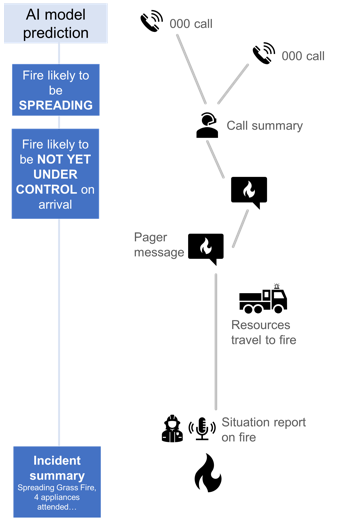
Source: Country Fire Authority
Scaling AI for Tankers
Country Fire Authority, Victoria and NSW Rural Fire Service
The scaling AI for tankers project aims to field-test and scale AI object-detection algorithms to enable safer pump-and-roll firefighting, a dynamic tactic used for wildland fires where the tanker simultaneously drives and sprays water from a hose.
The project intends to reduce the need for crew members to be exposed on tanker decks or on foot during operations. This will be achieved by developing and optimising an edge-computing semantic segmentation AI model to classify fire edge in real time.
As part of this project, hazard detection capabilities to identify pedestrians, fences, trees, and other obstacles near vehicles to prevent collisions and injuries during low-visibility or high-stress conditions will also be trialled.
The project will progress the technology from Readiness Level 6 to 7 by collecting and validating diverse, labelled fireground data—accounting for smoke, glare, night, and vibration—to ensure algorithm reliability in real world conditions while testing visible and infrared camera options.
Additionally, this project will enable the exploration of algorithms for use on Air Attack Supervisor and Air Tactical Group Supervisor aircraft to provide aircrew with improved intelligence when the fireground is obscured by smoke or dense canopy.
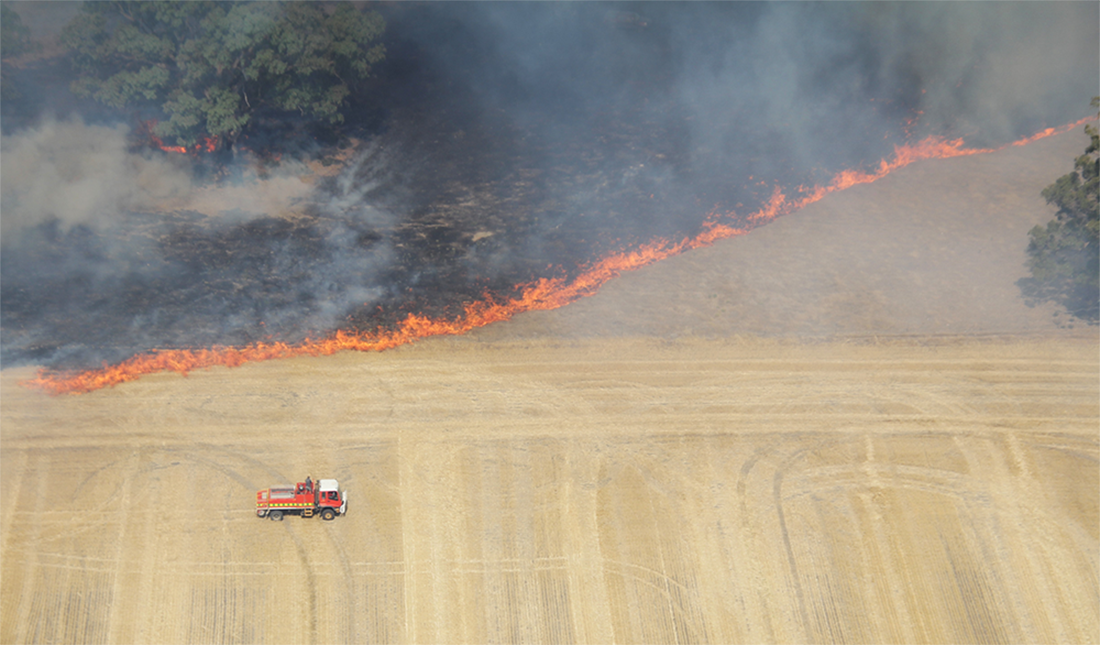
Source: Country Fire Authority
AI Grass Curing Estimator
South Australian Country Fire Service
The AI Grass Curing Estimator project will provide a proof of concept for a practical, field-deployable tool (application) that uses machine learning to automatically estimate grass curing percentages from simple photographs taken with a smartphone or drone.
When fully developed, the system will allow users such as volunteers or landholders, to capture a photo, upload it, and receive an instant curing estimate based on the AI algorithm developed by this project.
When a user uploads a photo, the app extracts metadata (location, date, lighting), performs cloud-based inference, and returns a predicted curing percentage and uncertainty score. Observations are then combined with satellite data to produce a spatial curing layer that updates dynamically across the landscape and can be integrated with the Australian Fire Danger Rating System and Spark Operational spread simulator.
By shortening the chain from field observation to operational simulation and public alert, this project directly supports the Collaborative’s goal of using AI to reduce wildfire impacts.
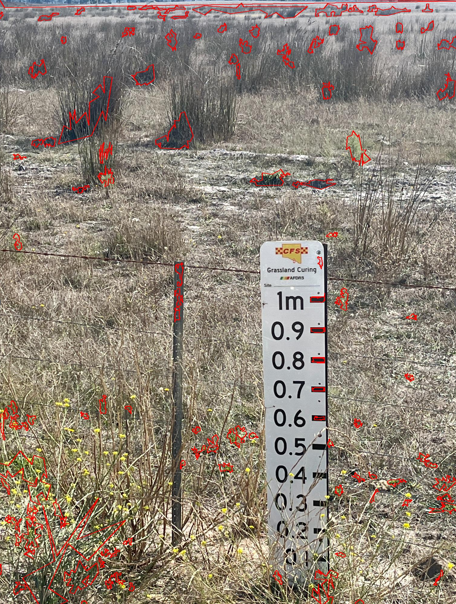
Source: South Australian Country Fire Service
SkySeekFire
Department of Energy, Environment and Climate Action (DEECA) and Country Fire Authority, Victoria
Lightning ignited bushfires can smoulder for many hours with no visible signs of fire activity (i.e. flames and smoke) and current bushfire detection methods rely on bushfires being visual to the naked eye, or large enough to be detectable using satellite technology.
This project aims to detect fires in the smouldering stage using aerial infrared technology across multiple platforms, before the fire becomes visible, more active and difficult to supress.
The SkySeekFire project will ignite multiple small non-visible smouldering fires in a designated area and will deploy aerial infrared platforms and Unmanned Aerial Vehicles platforms to determine whether they can detect those fires unaided. Multiple flight days will be undertaken to trial flight altitude, swade width and temperature sensitivity to find the optimum detection settings.
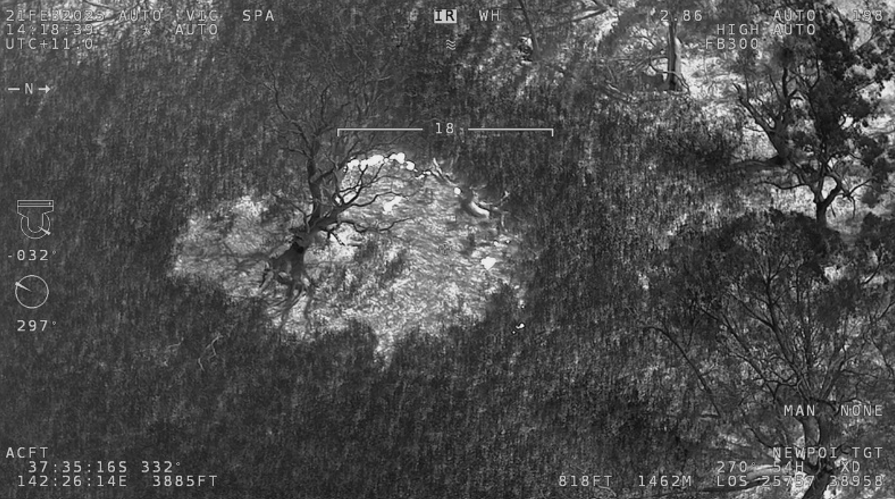
Source: DEECA and Country Fire Authority
Learn more about the Bushfire Emerging Technologies Hub project here: https://www.afac.com.au/public-resources/bushfire-emerging-technologies-hub-project-