
Overview
In Australia, formal fire danger ratings were first produced in the 1950’s and 1960’s by A. G. McArthur. The McArthur system was used for many decades and has undergone various modifications during its lifespan.
The introduction of the Australian Fire Danger Rating System (AFDRS) in 2022 was the most significant change to the forecasting of fire danger in Australia in the last 50 years. Its introduction delivered detailed, geographically specific, science-based data and analysis in support of Australia’s emergency management sector and their role in enhancing community safety.
The planning, development and implementation of the AFDRS required national collaboration of a scale never before seen in Australia’s emergency management sector. The scale of this change was considerable in its size, nature and complexity. Not only did the AFDRS introduce the use of the latest science and technology to better reflect environmental and weather conditions, the design and implementation of the AFDRS was a large-scale change management undertaking.
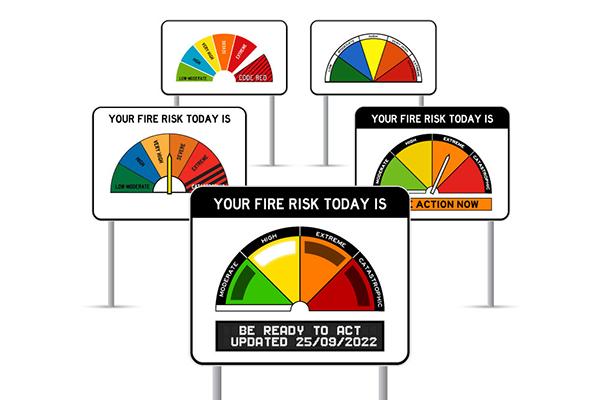
Image: Fire Signs through the decades designed by NSW Rural Fire Service communications.
Design
Explore the key components of the AFDRS and they include the Fire Danger Ratings, Fire Behaviour Index and components of the operational build
Learn moreBackground
Learn about AFDRS project development. the three-phase approach and the timeline walkthrough
Learn moreAFDRS publications
Access the publications like feasibility studies, research prototype, social research, cost benefit analysis and journal articles.
Learn moreProjects
Explore AFDRS projects like Fire Ignition, Suppression and Impact Index and the Utility Sector Engagement Project.
Learn more